
Introduction
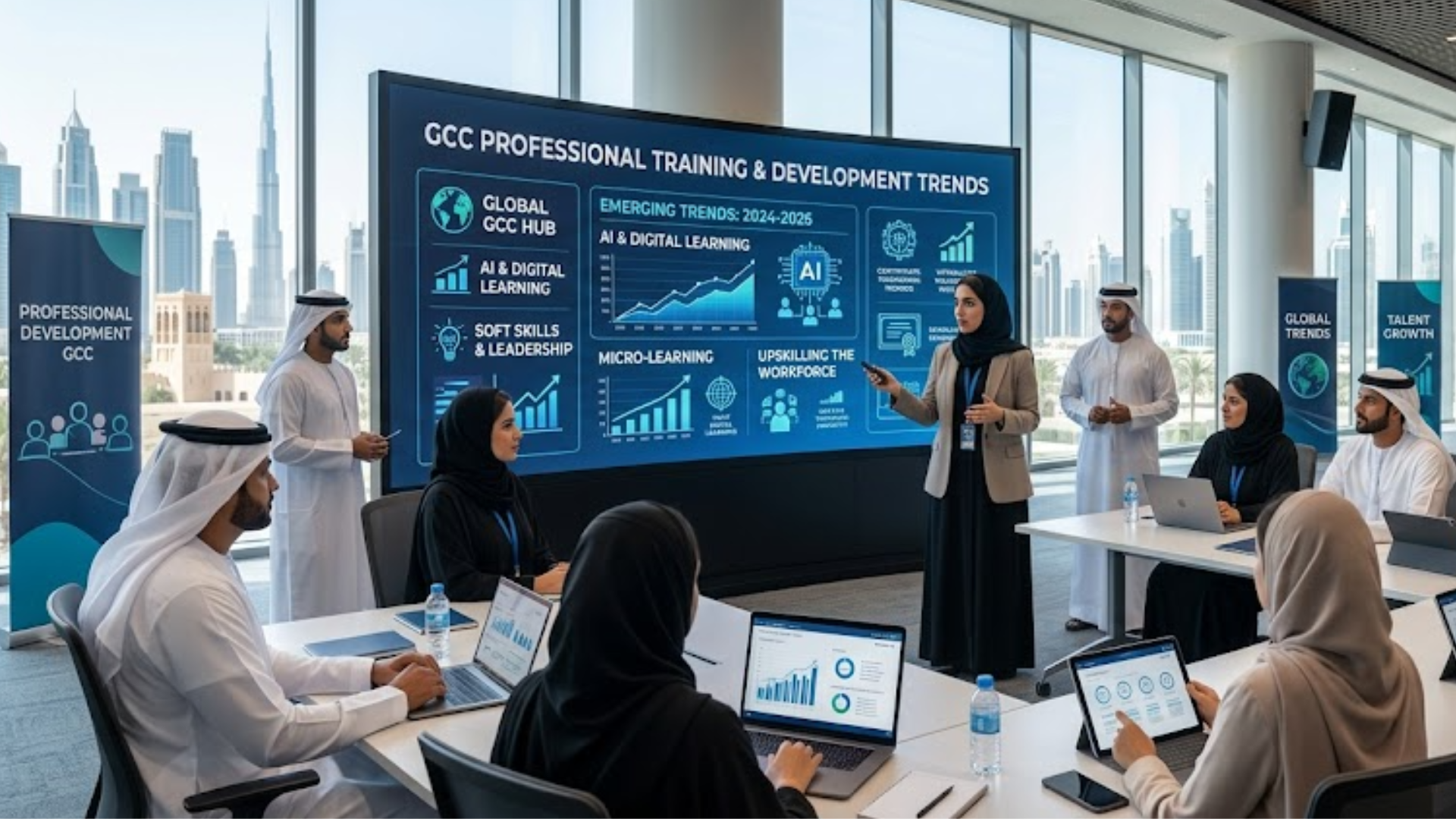
The professional training and development landscape across the GCC is changing rapidly. Organizations are operating in markets shaped by digital transformation, economic diversification, new technologies, changing workforce expectations, and increasing demand for specialized skills.
As businesses in the UAE, Saudi Arabia, Oman, Qatar, Kuwait, and Bahrain continue to evolve, employee development is becoming a strategic priority rather than simply an HR activity.
Companies are increasingly asking a more important question: how can training and development directly contribute to business performance?
This shift is changing the way organizations approach corporate training. Instead of focusing only on delivering courses, businesses are looking for practical learning solutions that strengthen capabilities, develop leaders, improve productivity, and prepare employees for future roles.
Understanding the major professional training and development trends in the GCC can help organizations make better decisions about their workforce strategies and learning investments.
The Growing Importance of Workforce Development in the GCC
The GCC has experienced significant economic and organizational transformation over the past decade. Businesses are expanding into new sectors, adopting advanced technologies, and developing more diverse workforces.
These changes have created demand for professionals with both technical and soft skills.
Organizations increasingly need employees who can:
- Adapt to changing business environments
- Use new technologies effectively
- Lead diverse teams
- Solve complex problems
- Communicate across cultures
- Make data-informed decisions
- Manage projects effectively
- Support innovation and transformation
Professional training provides organizations with a structured way to develop these capabilities internally.
1. Leadership Development Is Becoming a Strategic Priority
Leadership development remains one of the most important training trends across the GCC.
As organizations grow and transform, they need managers who can do more than supervise day-to-day operations. Modern leaders are expected to manage change, develop employees, improve performance, and contribute to strategic decision-making.
Leadership development programs are increasingly focusing on areas such as:
- Strategic leadership
- Emotional intelligence
- Coaching and mentoring
- Decision-making
- Change management
- Conflict resolution
- Team performance
- Executive communication
Organizations are also placing greater emphasis on developing internal leadership pipelines rather than relying entirely on external recruitment for senior positions.
2. Digital Skills and AI Training Are Expanding
Digital transformation is reshaping almost every industry in the GCC.
Organizations are adopting artificial intelligence, automation, cloud technologies, data analytics, and digital platforms to improve operations and customer experiences.
However, technology investment only creates value when employees know how to use it effectively.
As a result, organizations are increasing their focus on digital skills development, including:
- Artificial intelligence awareness
- Data analytics
- Digital productivity
- Cybersecurity awareness
- Technology adoption
- Automation
- Digital transformation
AI is particularly important because its impact extends beyond technical teams. Professionals across HR, finance, marketing, operations, sales, and management increasingly need to understand how AI can affect their roles.
3. Soft Skills Are Receiving Greater Attention
Technical expertise alone is no longer enough to succeed in a modern workplace.
Organizations across the GCC are increasingly investing in interpersonal and professional skills that support collaboration, leadership, and workplace effectiveness.
Important areas include:
- Communication
- Emotional intelligence
- Teamwork
- Problem-solving
- Negotiation
- Presentation skills
- Time management
- Adaptability
These capabilities are particularly important in the GCC’s multicultural business environment, where employees often work with colleagues, customers, and stakeholders from different cultural and professional backgrounds.
4. Professional Certifications Are Gaining Importance
Professional certifications continue to play an important role in career development.
Employees are increasingly seeking recognized credentials that demonstrate specialized knowledge and professional competence.
Organizations also benefit when employees pursue relevant certifications because certified professionals can strengthen internal capabilities and bring recognized industry practices into the workplace.
Certification-focused development can cover areas such as:
- Human resources
- Project management
- Facilities management
- Finance
- Risk management
- Quality management
- Supply chain
- Leadership
For employers, professional certification can also support succession planning and career development initiatives.
5. Customized Corporate Training Is Growing
Organizations are moving away from purely generic training programs and looking for solutions that reflect their specific business challenges.
Customized corporate training allows organizations to adapt learning around:
- Organizational objectives
- Industry requirements
- Employee skill gaps
- Internal processes
- Leadership priorities
- Workplace challenges
This is particularly valuable for organizations operating in specialized industries where standard training content may not fully address operational realities.
Customized training also makes it easier for participants to connect learning with their actual responsibilities.
6. Blended and Flexible Learning Models
The growth of digital learning has changed expectations around how professional development is delivered.
Organizations are increasingly combining different learning formats, including:
- Classroom training
- Live online training
- Self-paced learning
- Virtual workshops
- Coaching
- Practical workplace assignments
Blended learning can provide the flexibility of online education while maintaining the interaction and practical application associated with instructor-led training.
For GCC organizations operating across multiple countries, flexible delivery can also make it easier to provide consistent development opportunities to employees in different locations.
7. Learning Is Becoming More Practical and Experience-Based
Employees want training that they can use immediately.
As a result, organizations are placing greater emphasis on experiential learning rather than relying entirely on presentations and theoretical content.
Modern training programs increasingly use:
- Case studies
- Simulations
- Role plays
- Business scenarios
- Group problem-solving
- Practical exercises
- Workplace projects
This approach helps participants connect concepts with real business situations and increases the likelihood that learning will translate into workplace performance.
8. Employee Experience Is Influencing Learning Strategies
Employee expectations are changing across the GCC. Professionals increasingly value opportunities to learn, develop, and progress within their organizations.
Learning and development therefore plays an important role in the broader employee experience.
Organizations are using professional development to support:
- Employee engagement
- Career progression
- Internal mobility
- Retention
- Leadership pipelines
- Succession planning
When employees can see a clear connection between learning and career opportunities, training becomes more meaningful.
9. Data and Measurement Are Becoming More Important
Organizations are becoming more conscious of the need to demonstrate the value of training investments.
Instead of measuring success only through attendance or participant satisfaction, businesses are increasingly interested in whether training produces measurable improvements.
Training effectiveness can be assessed through:
- Knowledge assessments
- Skills evaluations
- Participant feedback
- Manager observations
- Performance indicators
- Business outcomes
This shift toward measurement helps organizations identify which development initiatives are creating real value and where improvements are needed.
10. Training Is Becoming More Closely Connected to Business Strategy
Perhaps the most important trend is the growing connection between learning and business strategy.
Training departments are increasingly expected to support organizational priorities rather than operate separately from them.
For example, if an organization is expanding into a new market, training may focus on leadership, cross-cultural communication, and market-specific capabilities.
If a company is implementing new technology, learning programs may focus on digital adoption and change management.
If an organization is trying to improve customer experience, training may focus on communication, service excellence, and customer relationship management.
This strategic alignment ensures that professional development contributes directly to organizational objectives.
What These Trends Mean for GCC Organizations
The changing training landscape presents both opportunities and challenges for businesses.
Organizations that continue to rely on generic, one-time training may struggle to keep pace with changing workforce requirements.
Companies that take a more strategic approach can use learning and development to build capabilities before skill gaps become major business problems.
A strong professional development strategy should therefore consider:
- Current capability gaps
- Future workforce requirements
- Business strategy
- Leadership succession
- Technology changes
- Employee career expectations
- Training effectiveness
This allows organizations to move from reactive training to proactive capability development.
The Future of Professional Training in the GCC
The future of professional training across the GCC will likely be shaped by a combination of technology, personalization, practical learning, and strategic workforce development.
Organizations will increasingly need learning solutions that are:
Relevant: Connected to real business needs.
Practical: Focused on workplace application.
Flexible: Available across different learning formats and locations.
Measurable: Linked to performance and business outcomes.
Future-focused: Designed around emerging skills and changing job requirements.
The role of trainers is also evolving. Modern trainers are increasingly expected to act as facilitators, advisors, and capability development partners rather than simply delivering presentations.
How Solomon People Solutions Supports Organizations Across the GCC
At Solomon People Solutions, we help organizations strengthen workforce capabilities through corporate training, consulting, and talent solutions.
Our approach focuses on understanding organizational requirements and creating practical development solutions that support business objectives.
We work with organizations across areas such as:
- Leadership and management development
- Professional skills
- Human resources
- Project management
- Technical and industry-specific training
- Organizational development
- Employee capability development
With organizations operating across the UAE, Saudi Arabia, Oman, and the wider GCC, professional development needs to reflect both regional business realities and international standards.
Conclusion
Professional training and development in the GCC is moving toward a more strategic, practical, and results-focused approach.
Leadership development, digital skills, AI, professional certifications, soft skills, customized training, blended learning, and measurable outcomes are becoming increasingly important as organizations prepare their workforces for the future.
For businesses, the key is not simply to provide more training. It is to provide the right training at the right time, connected to the capabilities the organization needs to succeed.
Organizations that make workforce development a strategic priority can build stronger teams, develop future leaders, adapt more effectively to change, and create a more capable workforce for the next stage of growth.
